Securing the Series A: Mastering Biotech Pitch Q&A Prep
In the world of biotech, a pitch isn’t just a presentation—it’s high-stakes Q&A prep. You aren’t just selling a vision; you’re defending intellectual property, regulatory pathways, and market scalability.
Following our deep dive into PhD defense preparation, we wanted to pivot to the boardroom. We took a real-world biotech pitch deck and put it through the qame.ai ringer to see if our AI personas could act as a specialized Q&A prep partner, sniffing out the same “deal-breakers” that professional VCs do.
By the way, if you are curious about the source, this is a real pitch deck for a company attempting to revolutionize vertical indoor farming; you can find it here.
For this session, we simulated a founder preparing for a Series A round, focusing on a breakthrough in agricultural biotechnology.
Assembling the Investment Committee
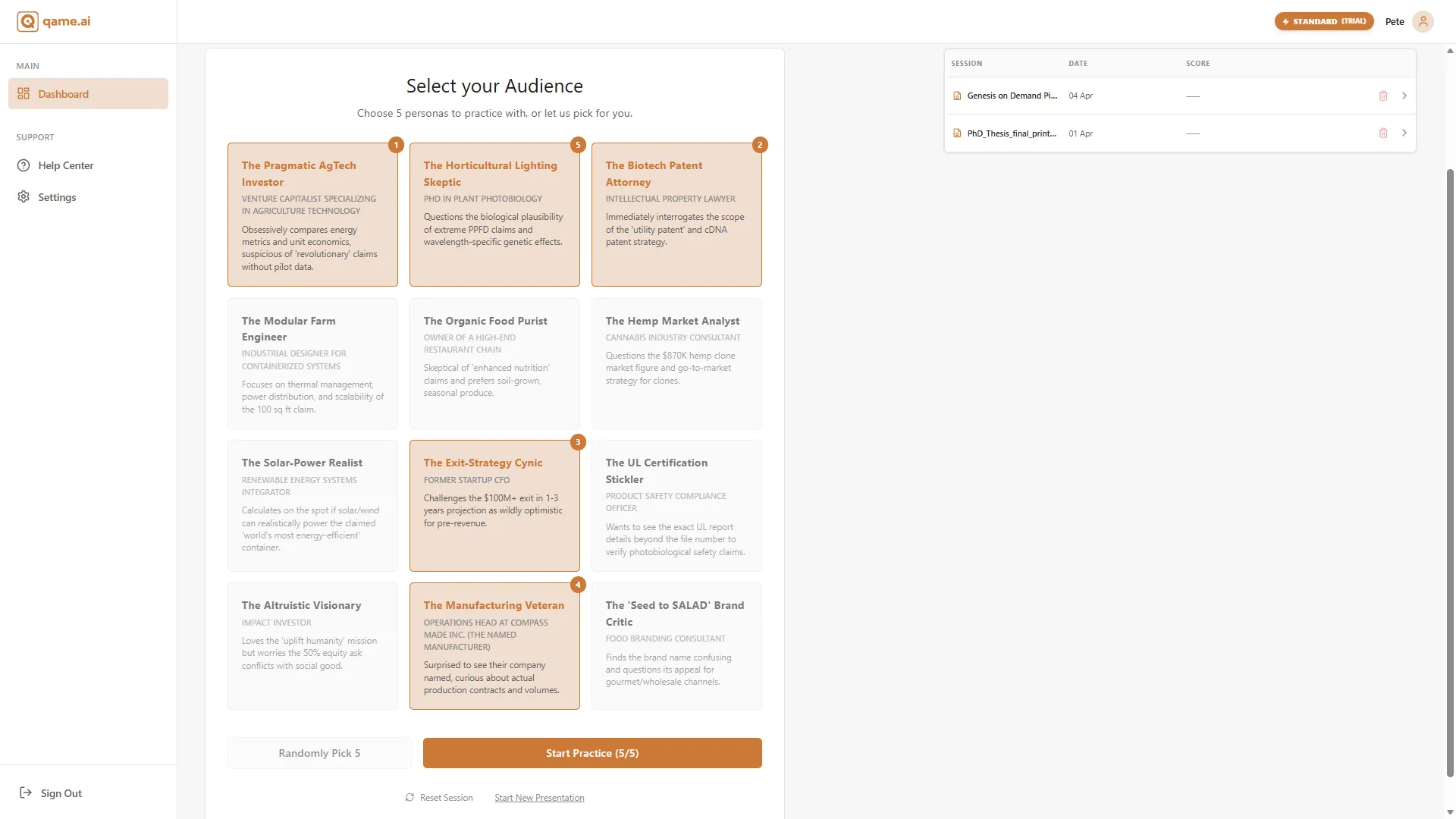
Strategy is everything. In a real pitch, you don’t just get generalized feedback; you get specific, often “hairy” questions based on the listener’s background. We uploaded our deck and qame.ai generated a specialized panel of 12 experts.
From that list, we hand-picked a 5-member “gauntlet” to ensure every angle of the business was stress-tested:
- The Biotech Patent Attorney: To grill us on IP defensibility.
- The Pragmatic AgTech Investor: To hunt for unit economic flaws.
- The Manufacturing Veteran: To question our scale-up timeline.
- The Horticultural Lighting Skeptic: To challenge our core tech assumptions.
- The Exit-Strategy Cynic: To poke holes in our long-term ROI.
We chose this specific mix because they represent the “deal-breakers”, the specialists who can derail a funding round if their specific concerns aren’t addressed with confidence.
The goal here isn’t just to practice speaking, it’s to find the logic gaps in the business model before a real investor does.
While we sparred with all five, we’re going to highlight the two most intense interactions from the session.
The “Hairy” Questions
Once we hit “Start Session,” the AI didn’t hold back. Unlike traditional AI tools that just give you text to read, qame.ai forces you to actively listen to the persona’s voice. This is a critical distinction: in a real pitch, you don’t get a transcript of the investor’s question,you have to catch the nuance in their tone and the subtext of their skepticism in real-time.
We used the system’s recording feature to respond verbally, just like a live pitch. This also allows you to listen back to your own responses, a sometimes humbling but necessary step to identify your “filler words,” logical lapses, or defensive tones.
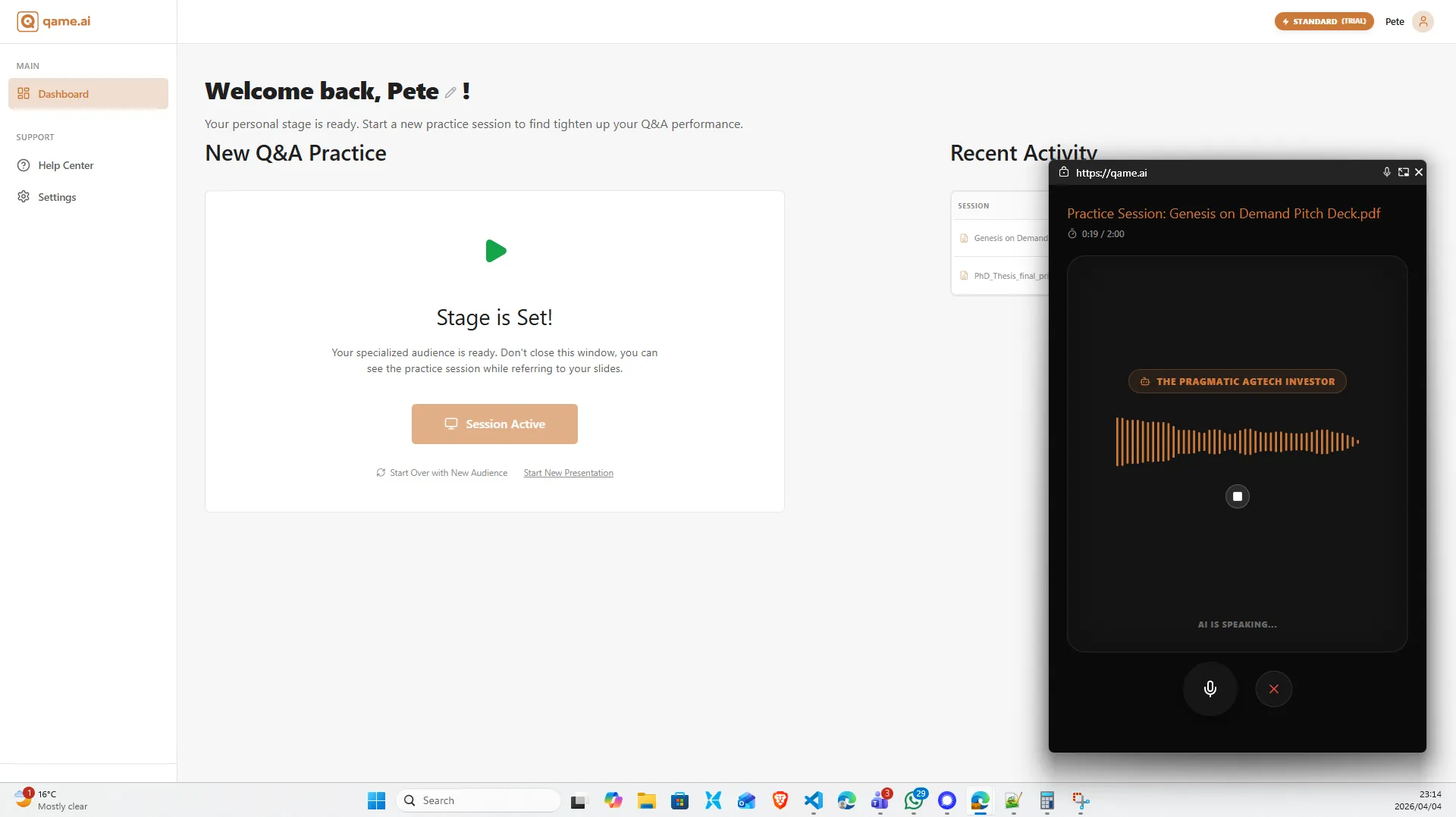
The AgTech Investor: “Where is the third-party validation?”
The AgTech Investor immediately went for the throat on technical feasibility. They flagged a massive discrepancy between our claimed PPFD (which was 93 times higher than competitors) and our power consumption of only 96W.
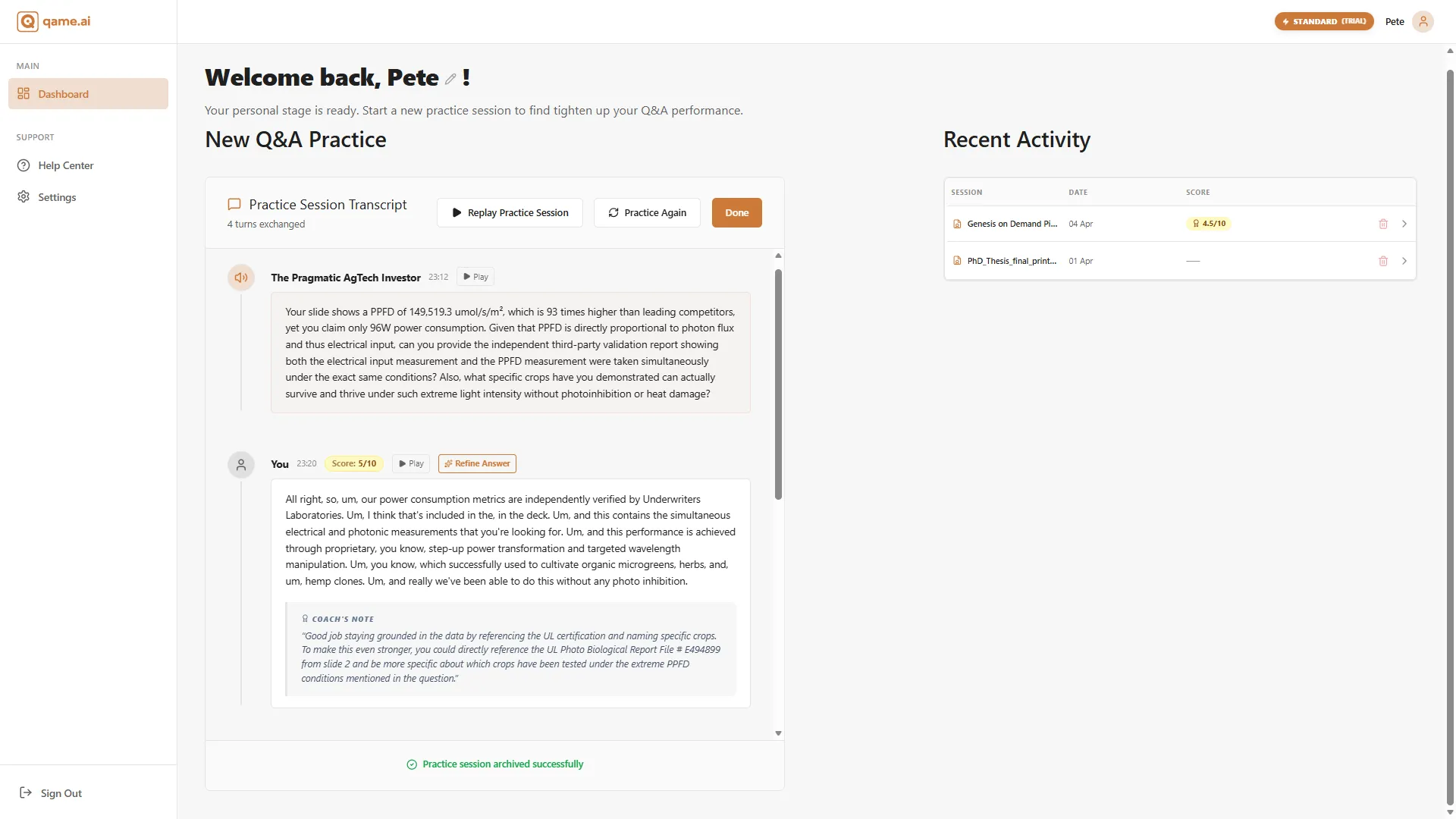
The persona demanded independent validation showing both the electrical input and the light intensity measurements were taken simultaneously. They also probed on whether any specific crops could actually survive such extreme intensity without photoinhibition or heat damage.
Listen to the nuance in the AI’s challenge regarding these technical claims:
The Verdict: We scored a 5 out of 10 on this response. The persona’s feedback was highly specific:
“Good job staying grounded in the data by referencing the UL certification and naming specific crops. To make this even stronger, you could directly reference the UL Photo Biological Report File # E494899 from slide 2 and be more specific about which crops have been tested under the extreme PPFD conditions mentioned in the question.”
The Biotech Attorney: “Is this yours to sell?”
Next, the Biotech Attorney pivoted the conversation to IP (Intellectual Property). Unlike a general “business lawyer,” this specialist went deep into the USPTO guidelines regarding what can and cannot be patented.
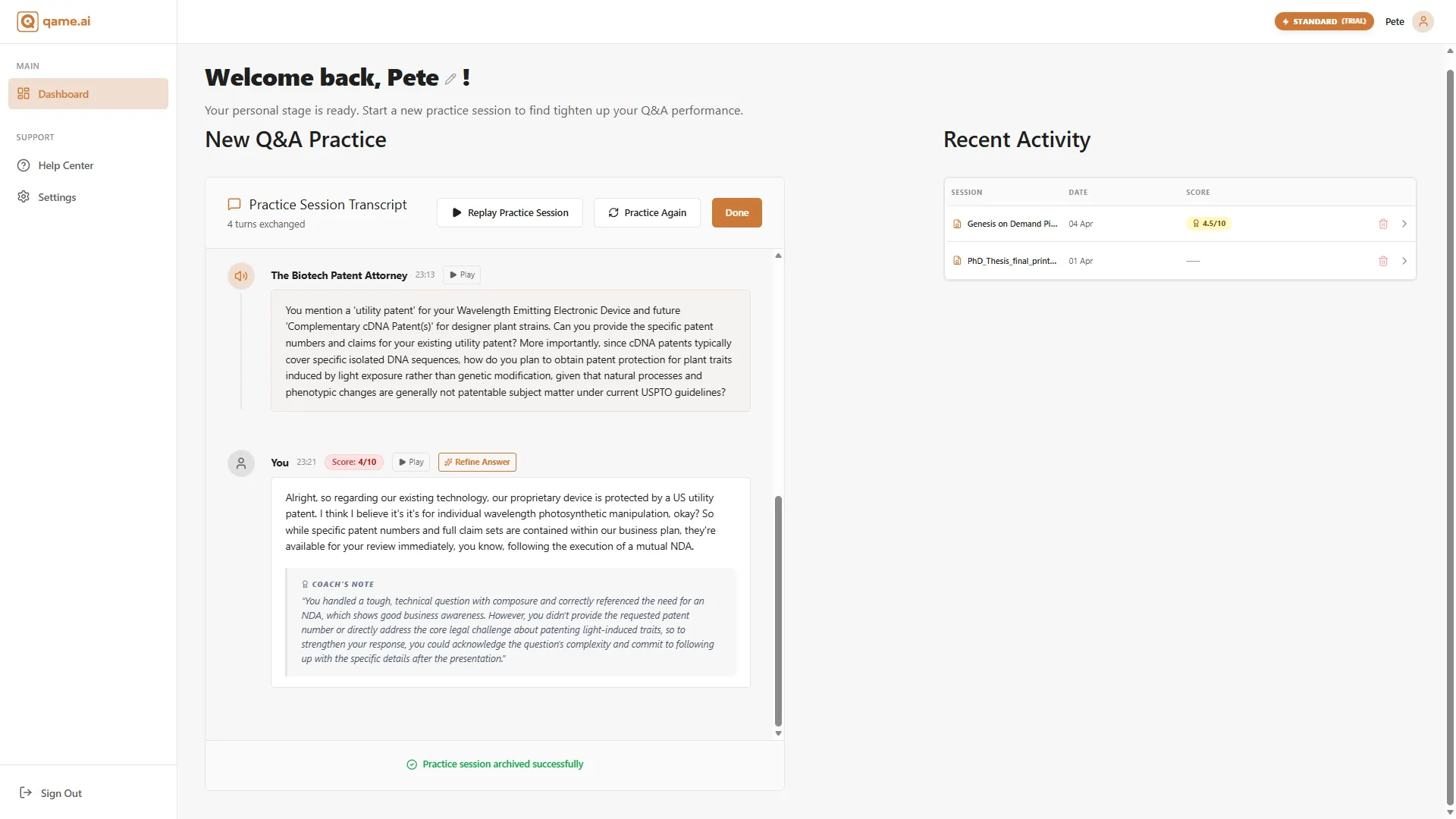
The AI challenged our strategy for obtaining patent protection for plant traits induced by light exposure rather than genetic modification, noting that natural processes and phenotypic changes are generally not patentable subject matter. It also pushed for specific utility patent numbers and claims that we weren’t fully prepared to defend on the fly.
Listen to the AI probing the patent strategy and legal subject matter:
The Verdict: Our performance dropped here to a 4 out of 10. The attorney persona’s critique cut straight to the core of the deal’s risk:
“You handled a tough, technical question with composure and correctly referenced the need for an NDA, which shows good business awareness. However, you didn’t provide the requested patent number or directly address the core legal challenge about patenting light-induced traits, so to strengthen your response, you could acknowledge the question’s complexity and commit to following up with the specific details after the presentation.”
It’s one thing to have a polished presentation; it’s another to deal with an expert who knows the exact technical gaps in your IP narrative. This “hairy” exchange forced us to realize that we weren’t just practicing a pitch, we were preparing for an audit.
The Power of the Pivot: Refining Your Answer
This is where the platform’s “Refine” feature becomes a game-changer. After receiving those scores (5/10 and 4/10), we didn’t just walk away with a bruised ego. We used the AI’s specific critique to rewrite our responses and re-recorded the exchange.
By refining our answers within the tool, we were able to:
- Incorporate the farm ROI data the AgTech investor was looking for.
- Clarify the specific FTO (Freedom to Operate) boundaries for the attorney.
By the time we finished the session, we had more than just a practiced speech; we had a list of 5 specific slide updates needed to address the “hidden” questions we hadn’t even written into our script.
Master Your Pitch
Whether you are defending a thesis or a $10M valuation, the principle remains the same: You don’t know your pitch until you’ve nailed the Q&A prep.
Using AI personas to simulate the personalities and biases of your audience allows you to build a “fireproof” narrative. You learn to anticipate the skepticism, handle the technical deep-dives, and, most importantly, pivot back to your key value proposition.
Founding a startup? Don’t walk into your next investor meeting without proper Q&A prep. Try qame.ai today and stress-test your vision against the experts.
← Back to Blog